
Why I Came Home To Build.
Trinidad and Tobago is full of brilliant entrepreneurs, ambitious business owners, and talented people. We are creative, resourceful, and resilient. We know how to make things happen. What we don't always consider are how we can ensure those things keep happening — consistently, sustainably.
Most people assumed I'd stay in London.
Nearly 30 years abroad will do that - the years become their own argument.
I left Trinidad at 16, landed in New York, spent a year apprenticing with a dance company before joining the inaugural class of the Ailey/Fordham BFA programme and working in the business office of the Ailey School. By the time I graduated, the thing I had been subconsciously learning my entire life became part of my DNA and has shaped everything I've done since: that excellence at the highest level isn't just talent. It's discipline, structure, and systems that make the talent sustainable.
My career moved through theatre, music tech, health-tech, and law. From professional stages to senior operational roles. From New York to London, where I spent two decades building the infrastructure to match the organisation’s ambition.
There was no obvious reason to leave, but also none to stay.
I came back home because I wanted to, and I could. It sounds simple, and in the most important sense, it is.
But, I came back having spent nearly three decades watching how organisations work — and, more often, how they quietly don't.
Every time I came home, my observations became more of a reality.
Trinidad and Tobago is full of brilliant entrepreneurs, ambitious business owners, and talented people. We are creative, resourceful, and resilient. We know how to make things happen. What we don't always consider are how we can ensure those things keep happening — consistently, sustainably.
[btw, this isn’t only how we do business, it’s how we are governed and how we lime]
And here's what that actually looks like:
→A business that runs smoothly when the right person is in the room, and wobbles the moment they're not.
→A team that's capable but unclear — not because they don't care, but because no one has ever made the expectations, the processes, or the decision rights explicit.
→A leader doing the work of three roles, not because they have to, but because the systems that would free them up haven't been built yet.
And underneath it all, a culture quietly shaped by those gaps — where people learn to work around problems rather than through them, because that's what the environment has always rewarded.
These symptoms often look like people problems,
〰️ Poor communication. Lack of accountability. Low productivity. Decision paralysis. Team conflict. Leadership burnout. 〰️
Beneath many of those challenges sits something deeper.
The business hasn't evolved at the same pace as its ambition.
〰️ Processes haven't kept up. Roles aren't clearly defined. Decision-making isn't structured. Knowledge lives in people instead of systems. Leadership struggles with supporting and managing their people. 〰️
The issue isn't a lack of vision or capability.
Teams haven't been equipped for the demands of growth, that creates pressure instead of momentum.
It's that most T&T businesses are still built for survival. And there is a significant difference between a business built to survive and a business built to scale.
Survival runs on heroic effort — long hours, institutional memory, getting things done under the wire with luck and vibes, a Founder who remembers everything. That works, until it doesn't.
Scale demands something else entirely: clarity of roles, repeatable systems, leadership that develops rather than directs, and governance that holds under pressure. These aren't luxury additions. They are the foundation.
This is where the people and leadership dimension matters as much as the operational one — and where the most meaningful transformation happens.
Systems without the right leadership culture behind them don't stick. And leadership without the systems to support it burns out. The businesses I've seen grow well aren't just the ones that fixed their processes. They're the ones that fixed how decisions get made, how accountability gets held, and how their people are developed alongside the organisation.
That's transformation. Not a workshop. Not a rebrand. The actual, specific, sometimes uncomfortable work of building something that holds.
What Is, Must Is was built around one idea: that most people problems are fundamentally systems problems. We know people work best when they know their parameters and boundaries, removing the guessing games and ad hoc firefighting allows the mind to free up, think creatively and solve problems. Even people who hide behind, ‘I’m a creative’ admit they are more effective when they have systems that support and enhance their creativity - hence managers.
The name reflects a principle I keep returning to. The current state is what it is » The future state is what it must be. The gap between those two things is the work — not the vision board, not the away-day, but the deliberate, unglamorous effort of closing the distance between where a business is and where it needs to be.
At Wi,Mi, we help SMEs bridge that gap — through operational design, people strategy, and the kind of leadership infrastructure that means a business is no longer dependent on any single person's memory or heroics. Based on the tried and tested theoretical frameworks, but brought to life through practical solutions that fit the reality of how organisations operate. We help leaders create clarity, build stronger teams, improve processes and establish the structures that allow growth to happen sustainably.
Coming home wasn't a step backwards. It was opportunity.
The Opportunity to bring a particular way of seeing, to apply everything I had learned - shaped by New York, refined in London, grounded in an understanding of how things work here - to the place that shaped me and businesses that are ready to stop surviving, and start scaling.
Not with a London playbook. T&T businesses don't need that, and it wouldn't fit. But with the rigour, the honesty, and the practical commitment to doing the work properly.
And if there is one thing I've learned from working across industries and continents, it's this:
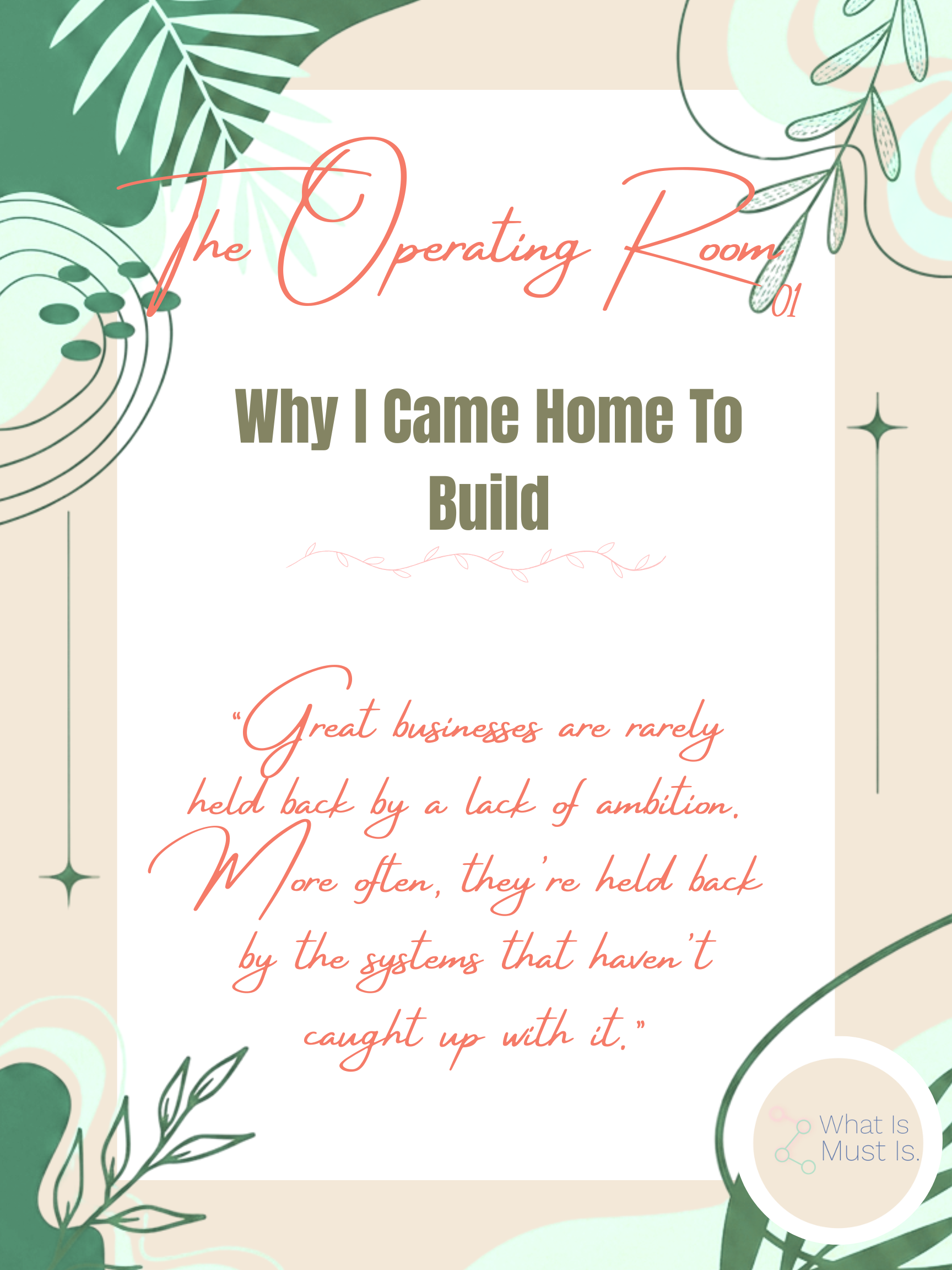
Great businesses are rarely held back by a lack of ambition. More often, they're held back by the systems that haven't caught up with it and limit the people.
That's the work that excites me.
And that's why I came home to build.
✶
If you recognise your business, or even had a similar conversation with other folks about what I've described - if the gap between where you are and where you need and want to be has become impossible to ignore - I'd be glad to have that conversation.
take care of you,
ZB.
This is the first piece in The Operating Room — a blog series exploring how ambitious businesses close the gap between where they are and where their operations need to be. Wi,Mi is based in Trinidad and Tobago and works with SMEs across the Caribbean and internationally. If your business is ready for that work, wherever you are, the conversation starts via 📋 contact form, 📧 email hello@whatismustis.com or 📆 book a chat one time.
